
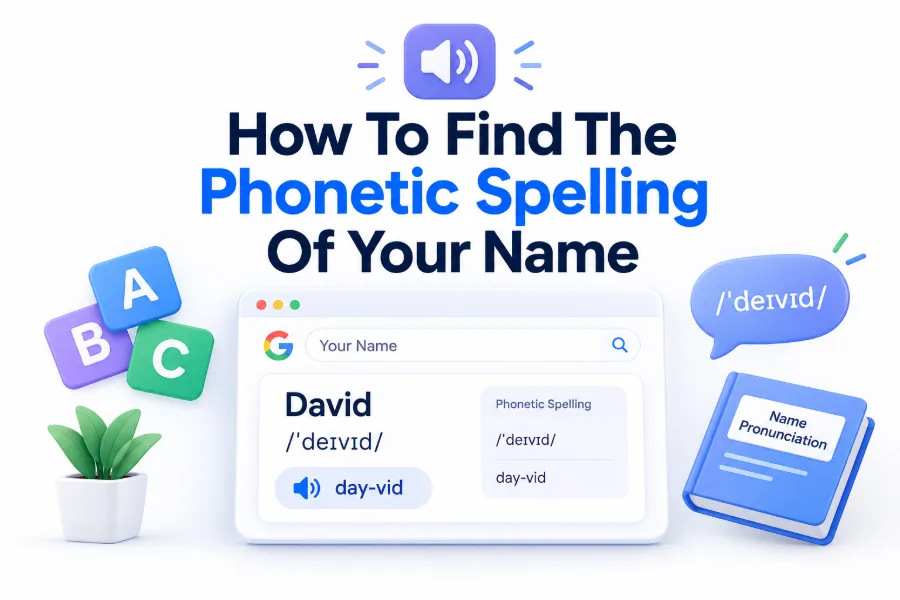
Names are personal, but they are also practical. They appear on job applications, school records, travel documents, medical forms, customer accounts, and video calls. When someone cannot pronounce your name correctly, a phonetic spelling gives them a respectful and useful guide. It turns an unfamiliar name into something they can say with greater confidence.
Learning how to find the phonetic spelling of your name does not require a language degree or expensive software. You need to listen closely to the way you say your name, break it into manageable sounds, and choose a spelling that makes sense for the people reading it. The best version is usually simple, readable, and accurate enough to prevent common mistakes. This article explains practical methods, examples, tools, and situations where phonetic spelling can make communication easier.
Why Phonetic Spelling Matters
A phonetic spelling shows people how a name sounds rather than how it is traditionally written. This is especially useful when a name comes from a language with pronunciation rules that differ from English. It can also help with names that have silent letters, unusual letter combinations, or several possible pronunciations.
Providing pronunciation guidance is not about changing your name to make it easier for others. It is about giving them a clear way to say it correctly. In workplaces, classrooms, healthcare settings, and customer-facing roles, this small detail can make conversations more respectful and less awkward from the start.
Where You May Need a Pronunciation Guide
Many online forms now include a pronunciation field, particularly on recruitment platforms, company directories, university portals, and event registration pages. A phonetic spelling can also be added to an email signature, staff profile, conference badge, or social media biography when your name is often mispronounced.
It is also useful before interviews, presentations, podcasts, and meetings with new clients. If a host introduces you publicly, sharing your pronunciation in advance avoids corrections in front of an audience. For families, a phonetic note can help teachers, doctors, caregivers, and coaches address children correctly.
Common Uses for Phonetic Name Spellings
- Job applications and employee profiles
- School enrollment and parent-teacher communication
- Medical and dental appointments
- Conference speaker biographies
- Wedding, graduation, and event programs
- Email signatures and professional websites
- Customer support systems
- Travel and airline bookings when names are spoken aloud
Start With the Way You Say Your Name
The most reliable source for pronunciation is your own voice. Say your full name naturally, as you would when introducing yourself. Do not slow it down too much at first. Listening to the normal rhythm helps you identify which syllables receive emphasis and which sounds tend to confuse other people.
Next, repeat the name more slowly and separate it into syllables. For example, “Marisol” may become “mah-ree-SOHL,” while “Niamh” may be written as “NEEV.” Focus on the sound, not the letters. Your written name may contain letters that readers would pronounce very differently.
Break the Name Into Syllables
Syllables are the sound units within a word. Dividing a name into syllables makes it easier for someone to read aloud, especially if the name has more than two parts. Hyphens are often the clearest choice because they show where one sound group ends and the next begins.
For example, “Adebola” might become “ah-deh-BOH-lah.” “Xiomara” could be written as “see-oh-MAH-rah.” The goal is not to create a technical dictionary entry. It is to give a reader a practical pronunciation guide they can use quickly in a real conversation.
Mark the Stressed Syllable Clearly
Stress affects how natural a name sounds. In English-friendly phonetic spelling, capitalizing the stressed syllable is one of the simplest methods. It helps people avoid placing emphasis on the wrong part of a name, which can change the sound significantly.
Consider the name “Priyanka.” A useful version may be “pree-YAHN-kah.” Without stress guidance, a reader may say “PREE-yahn-kah” or “pree-yan-KAH.” Neither is necessarily disrespectful, but a clear pronunciation guide reduces the need for repeated corrections and helps names sound closer to their intended form.
Quick Checks Before You Share a Phonetic Spelling
- Read the spelling aloud as if you have never seen the name before.
- Ask a trusted friend to pronounce it without hearing you say it first.
- Check whether the stressed syllable is easy to identify.
- Remove unnecessary symbols that may confuse general readers.
- Use familiar English sound cues where possible.
- Keep the guide short enough for forms, badges, and email signatures.
Use Familiar Sound Words
A practical phonetic spelling often relies on sound cues that English speakers already know. For example, “ee” commonly suggests the sound in “see,” while “ah” often suggests the vowel sound in “father.” These choices are not perfect for every accent, but they work well for general communication.
For a name such as “Aisling,” a reader-friendly pronunciation might be “ASH-ling.” For “Saoirse,” you may choose “SEER-sha” if that reflects your pronunciation. The best spelling is the one that helps your intended audience say your name more accurately, not the one that looks most technical.
Avoid Depending Only on Spelling Rules
English spelling is inconsistent, so relying on one letter pattern can create confusion. For instance, “oo” can sound different in “moon,” “book,” and “blood.” If a particular vowel is frequently misunderstood, choose a clearer sound combination or add a familiar comparison when space allows.
You might write “Róisín” as “roh-SHEEN” or add “rhymes with machine” in an informal setting. In a professional directory, the shorter phonetic version is usually better. When accuracy matters, an audio recording can support the written spelling and remove uncertainty caused by regional accents.
Examples of Reader-Friendly Phonetic Spellings
| Written Name | Phonetic Spelling | Helpful Note |
| — | — | — |
| Aoife | EE-fa | First syllable rhymes with see |
| Nguyen | WIN | Common English approximation |
| Siobhan | shiv-AWN | Stress falls on the second syllable |
| Joaquin | wah-KEEN | Final syllable rhymes with seen |
| Leilani | lay-LAH-nee | Keep the middle syllable open |
| Cian | KEE-an | Two syllables in this pronunciation |
| Anaya | uh-NYE-uh | Stress falls in the middle |
| Thuy | TWEE | A short, single-syllable guide |
Use a Dictionary-Style Pronunciation When Needed
Some situations require a more precise method than a simple English-friendly spelling. The International Phonetic Alphabet, often called IPA, uses symbols to represent specific speech sounds. Dictionaries, language resources, and pronunciation databases often use IPA because it can show detailed differences between sounds.
IPA is particularly useful for linguists, voice professionals, actors, language teachers, and international teams. However, many people do not know how to read its symbols. For most workplace forms and everyday introductions, a plain-language phonetic spelling is more useful than a technically exact transcription.
Know the Difference Between IPA and Plain Phonetics
A dictionary-style transcription may show a name with symbols such as /ˈniːv/ for “Niamh.” That is precise for readers who know IPA, but it may not help a colleague who simply wants to introduce you in a meeting. “NEEV” is usually more practical in that context.
You can use both versions when appropriate. Add an easy pronunciation guide to your public profile and keep an IPA transcription for specialist work. This approach protects accuracy while making the information accessible to different audiences and communication settings.
Ask Native Speakers and Family Members
If your name comes from a heritage language that you do not speak fluently, ask relatives or native speakers how they pronounce it. Names can vary by region, generation, family preference, and dialect. There may not be one universal answer, especially when a name has been adapted across countries.
This conversation can be meaningful as well as practical. A family member may explain which syllable carries emphasis, whether a vowel is longer than English speakers expect, or whether a sound has no perfect English equivalent. Their input can help you choose a pronunciation guide that respects the name’s origin.
Choose the Pronunciation You Actually Use
Your preferred pronunciation is valid, even if it differs from a traditional or regional version. People may pronounce their names differently after moving countries, growing up in multilingual families, or choosing a simpler form for daily life. A phonetic spelling should reflect the version you want others to use.
For example, a person named “Andrea” may say “AN-dree-uh” in one setting and “ahn-DRAY-ah” in another language context. If you use one version consistently at work, write that version. A pronunciation guide exists to support your identity, not to create a rule others can use against you.
Helpful Ways to Test Your Name Guide
- Read it aloud after leaving it alone for a day.
- Ask people from different backgrounds to try it.
- Test it in the exact form where it will appear.
- Listen for repeated errors and revise one sound at a time.
- Keep an audio recording for names with difficult consonants or tones.
- Use your preferred spoken version as the final authority.
Add Phonetic Spelling to Professional Profiles
A professional profile is one of the best places to include a pronunciation guide because it reaches colleagues before your first meeting. Add it beside your name, beneath your headline, or in an introductory sentence. For example: “Mireille Laurent, pronounced mee-RAY loh-RAHN.”
A simple note can improve introductions in virtual meetings, reduce errors in recorded announcements, and help managers model respectful behavior. If your company software supports a dedicated pronunciation field, use it instead of adding an overly long explanation to your profile biography.
Use It in Your Email Signature
An email signature gives recipients a quiet, repeatable reminder. You can place a phonetic spelling directly under your name, such as “Damilola Adeyemi | dah-mee-LOH-lah ah-deh-YEH-mee.” Keep the format clean, especially if your signature already includes a title, phone number, and company details.
For names with a close English comparison, a brief phrase may work well. “Maya Desai, pronounced MY-ah deh-SIGH” is easier to scan than a paragraph about pronunciation. If you receive frequent calls, adding a short audio link can be useful, provided your workplace allows external links.
Create an Audio Pronunciation Option
Written phonetics cannot capture every sound perfectly. Audio is helpful for tonal languages, rolled consonants, subtle vowel differences, and names that change rhythm depending on stress. A short, clear recording of you saying your name once or twice is usually enough for colleagues and event hosts.
Record the name in a quiet place and speak at a normal pace, followed by a slower version if needed. You can add the file to a company directory, speaker page, or personal website. Pairing audio with written guidance offers the clearest result for a diverse audience.
Keep Audio Recordings Simple and Clear
Avoid background music, long introductions, or recordings that include private information. The listener only needs your name and, if useful, a gentle repeat. A recording such as “Hello, my name is Ece Yılmaz. It is pronounced EH-jeh yuhl-MAHZ” is direct and easy to reuse.
Review the recording occasionally if your preferred pronunciation changes or if you create a new professional identity. For public-facing work, make sure the audio reflects the name you want clients, students, customers, or audiences to use when speaking with you.
Practical Tips for Different Name Types
| Name Situation | Recommended Approach |
| — | — |
| Silent letters | Write the sounds only, such as “NEEV” for Niamh |
| Long names | Divide into syllables with hyphens |
| Unfamiliar stress | Capitalize the stressed syllable |
| Multiple accepted versions | State your preferred version |
| Sounds absent in English | Use the closest cue and add audio |
| Names used internationally | Create a guide for your main audience |
| Hyphenated surnames | Spell each surname separately for clarity |
Avoid Common Phonetic Spelling Mistakes
One common mistake is making the guide too complicated. Excessive punctuation, technical symbols, and detailed linguistic notes can intimidate readers. Unless you are writing for a specialist audience, clarity is more valuable than precision that only trained speakers can interpret.
Another mistake is copying an online pronunciation without checking it. Websites and automated tools may use a regional variation, misread the name, or provide a pronunciation that does not match your preference. Always say the guide aloud and treat your own spoken name as the final reference.
Do Not Force English Sounds Too Far
Some names contain sounds that English cannot reproduce exactly. In that case, aim for a respectful approximation rather than pretending there is a perfect equivalent. A clear approximation helps people make a sincere effort, while an audio example can provide additional detail for those who want to learn.
If a sound is important to you, explain it briefly in a suitable setting. For instance, you might say that a consonant is softer, rolled, or produced farther back in the mouth. Keep the explanation friendly and practical rather than treating a small mistake as a test.
Correct People With Confidence and Grace
Most pronunciation mistakes happen because people have not been given guidance, not because they intend disrespect. A quick correction can be enough: “It is pronounced nah-DEE-ah, but thank you for asking.” This gives the person usable information without making the exchange uncomfortable.
When the same mistake continues, be more direct and consistent. Repeat the correct version at the beginning of meetings, update your profile, and ask managers or teachers to use it. Respectful pronunciation is part of respectful communication, and it is reasonable to expect people to make an effort.
A Simple Process You Can Repeat
- Say your name naturally.
- Separate it into syllables.
- Identify the syllable with the strongest emphasis.
- Write the sounds with familiar English spelling.
- Ask another person to read it aloud.
- Adjust any part they mispronounce.
- Add audio if the written version is not enough.
- Use the same guide across your key profiles.
Conclusion
A phonetic spelling is a practical tool that helps people address you with more care and confidence. Start with your own preferred pronunciation, divide the name into clear syllables, show the stressed sound, and choose familiar spelling cues for your audience. Test the result with another person before adding it to forms, profiles, or email signatures.
There is no need to make the process overly technical. A short guide such as “mah-REE-ah,” “shiv-AWN,” or “wah-KEEN” can prevent repeated errors and create a better first impression. When a written guide cannot fully explain the sound, a brief audio recording adds useful context. Once you know how to find the phonetic spelling of your name, you can use it wherever clear, respectful communication matters most.
FAQ
How do I write my name phonetically?
Say your name slowly, split it into syllables, and write the sounds using familiar English spelling. Capitalize the syllable that receives emphasis. Ask another person to read it aloud to check whether it produces your intended pronunciation.
Should I use IPA for my name?
IPA is useful when precise pronunciation matters or your audience knows phonetic symbols. For everyday forms, email signatures, and workplace profiles, a plain-language spelling is usually easier for most people to read and use correctly.
Can I choose a different pronunciation from my family?
Yes. Your phonetic spelling should show the pronunciation you prefer people to use. Family traditions, regional dialects, and personal identity can all influence pronunciation, and your daily spoken version is the most relevant guide.
What if my name has a sound English speakers cannot make?
Use the closest clear approximation and provide an audio recording when possible. You can also offer a short explanation of the difficult sound. Most people will appreciate guidance and improve quickly when they have a practical example.
Where should I include my phonetic spelling?
Add it to workplace profiles, email signatures, speaker biographies, school records, appointment forms, and event registrations. Use it wherever people may need to say your name before meeting you or introducing you publicly.
0 Comments